Tote Board Social Service Fund
Understand the impact and outcomes of the Tote Board Social Service Fund, to examine how the Fund has improved quality of life for adults and children in the community.
Last updated 29 December 2025
About Tote Board Social Service Fund
The Tote Board Social Service Fund (TBSSF) is a broad-based fund for the social service sector, and supports critical and strategic programmes for vulnerable communities, innovation and capital funding across various community programmes, and government co-funded programmes. It aims to improve the reach and comprehensiveness of social services by supporting programmes initiated by government and social service agencies (SSAs).
The fund was introduced in FY2006.
Key partners
Ministry of Social and Family Development (MSF)
Ministry of Education (MOE)
Agency for Integrated Care
Ministry of Health
National Council of Social Service (NCSS)
SG Enable
Service users
Vulnerable communities such as:
persons with disabilities
persons from disadvantaged backgrounds
those with mental health challenges
FY2019 to FY2022 tranche achievements
$580.4M
Funding
494,588
Number of service users
285
Number of supported programmes (average per year)
Theory of change illustrating the desired impact and outcomes of the TBSSF
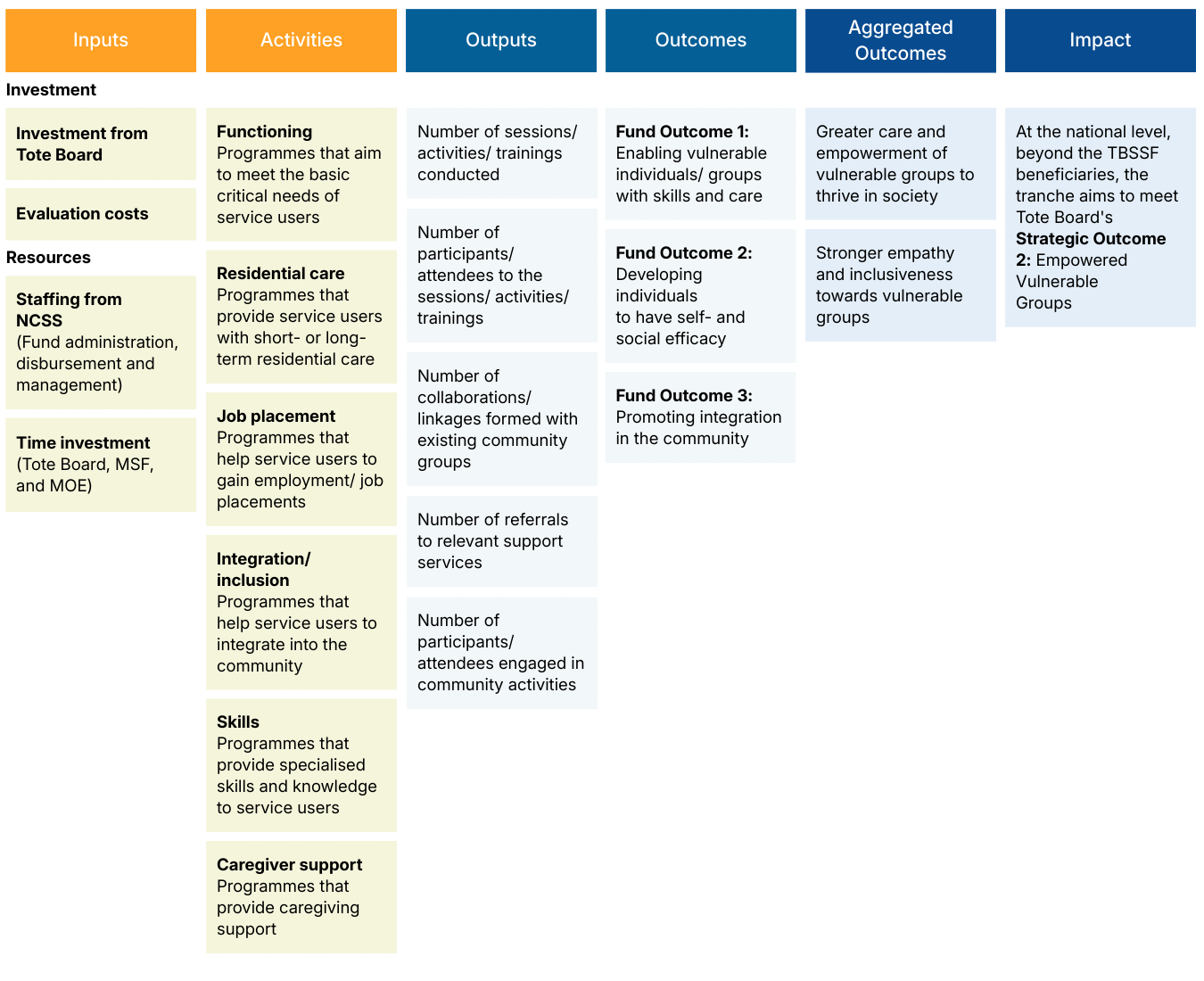
Download a high-res version of the infographic here [PDF,50 KB].
Implementation
The FY2019 to FY2022 tranche of TBSSF funding focused on the Family and Disability sectors, with the aim of facilitating enhancements and integration of services within the sub sectors. In particular, the Fund supported programme clusters which are complementary in nature in providing holistic support for service users, and/or provided options for users who required varying degrees of intervention.
This encouraged social service agencies to consider an ecosystem approach that offered effective longer-term solutions for service users instead of disparate programmes in silos.
Impact and outcomes
Between FY2019 and FY2022, the TBSSF supported an average of 285 programmes and 123,647 service users each year.
The impact of the TBSSF was measured using the World Health Organization's Quality of Life (QOL) Brief Version for adults1, and QOL – KIDSCREEN2 for children and youth under the age of 18.
The key dimensions that shaped QOL for the service users included:
physical and mental health status
financial security
degree of independence to engage in desired activities
strength of social support networks to meet their basic and social needs
degree of control they perceived to have across multiple aspects of their lives
Outcome and QOL scores of service users over programme participation duration
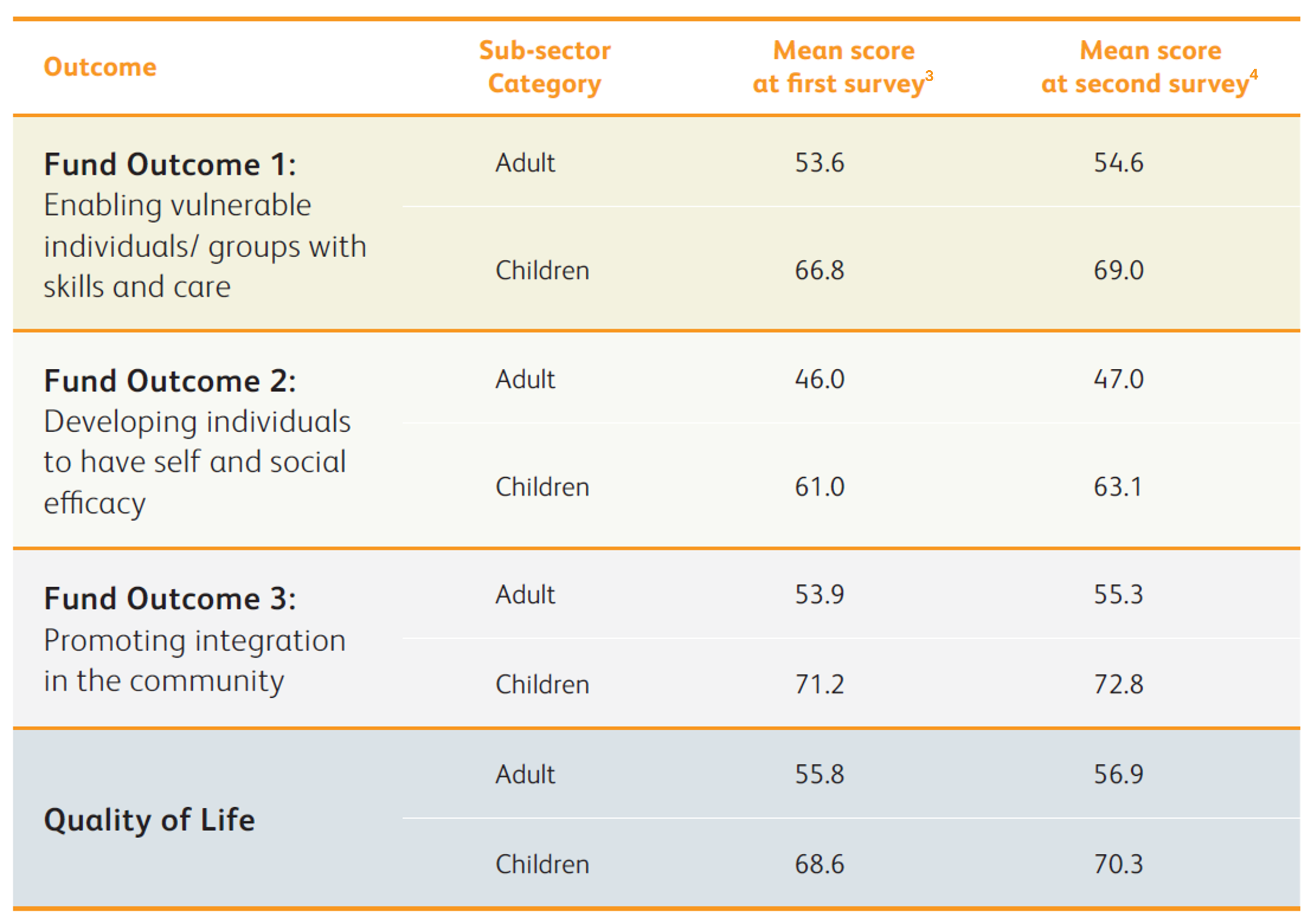
Both adult and children participants showed improvement for all TBSSF outcomes and QOL across time as they stayed in a TBSSF-funded programme. The evidence underscored the positive impact of the interventions.
1 The World Health Organization defines Quality of Life as an individual's perception of their position in life in the context of the culture and value systems in which they live and in relation to their goals, expectations, standards and concerns. The World Health Organization Quality of Life – BREF (WHOQOL-BREF) is a self-report questionnaire which assesses four domains of quality of life (QOL): physical health, psychological health, social relationships, and environment. In addition, there are two items that measure overall QOL and general health.
2 The KIDSCREEN is a widely used questionnaire designed to assess the quality of life (QOL) of children and adolescents. It covers various dimensions of well-being, including physical and psychological health, social relationships, and school environment. The KIDSCREEN questionnaire aims to capture the subjective well-being and life satisfaction of young individuals, providing insights into their overall QOL. It is a tool for understanding and evaluating the holistic well-being of children and adolescents in different contexts.
3 Conducted between April 2022 and March 2023
4 Conducted within a minimum of two weeks after the first survey