Impact Measurement
More than just tracking numbers, measuring impact is about understanding how we can create meaningful, lasting change in our communities.
Last updated 24 February 2026
Overview
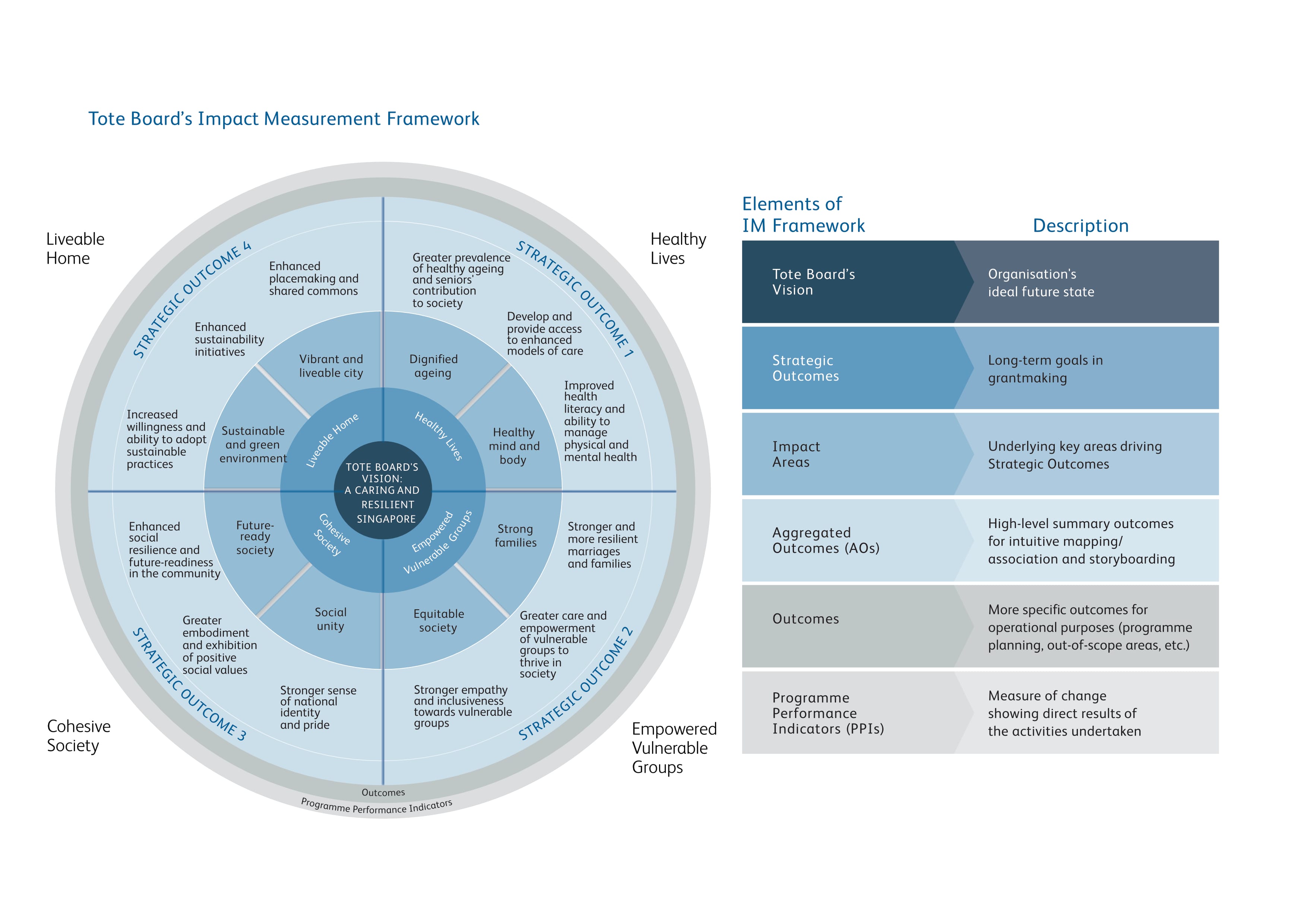
Established in 2022’s Strategic Review and aligned with national priorities, our grants framework transforms our vision into action through four strategic outcomes: Healthy Lives, Empowered Vulnerable Groups, Cohesive Society and Liveable Home. With clear programme performance indicators, and an evidence-driven approach, we ensure that every grant addresses community needs and delivers impact.
The broad-based framework also strengthens the impact measurement capabilities of both Tote Board and the non-profit ecosystem, enabling better decision-making, accountability and communication.
Better decision making:
Facilitates programme-level design changes
Provides a tool for assessing effectiveness and efficacy of programmes
Better accountability
Enables transparency in attributing impact that arises because of the programme
Supports the meeting of output and outcome targets
Better communication and branding
Enables a social impact narrative for partners to share with stakeholders
Enhances the profiling and promotion of key programmes
Impact Measurement Framework
The Tote Board Impact Measurement Framework centres on our Strategic Outcomes, which are the long-term goals that Tote Board aims to achieve through our grantmaking activities.
Property of Tote Board, Copyright @ 2025
Impact Measurement involves:
Theory of Change designed with grant partners to achieve the desired outcomes of giving, as well as to fulfil our vision of "A Caring and Resilient Singapore"
Programme Performance Indicators to assess the programme’s success. Set based on Tote Board’s 4A Change Model, these help to define change for beneficiaries in the following ways:
Attitude: shifting mindsets and beliefs
Ability: acquiring essential skills and capabilities
Access to resources: creating pathways to essential resources and opportunities
Action: fostering behaviour change through sustained action in the longer term
Data Collection Plan devised with our partners to track the indicators and evaluate programmes. As the depth and scale of measurement differ for each programme, the data will be interpreted according to specific contexts and goals.
The example below illustrates the application of the Tote Board IM Framework in setting programme outcomes and developing measurement metrics.
Example: Awareness campaign for a programme to enhance mental well-being
Strategic Outcome (SO) | Aggregated Outcome (AO) | Programme Outcomes | Programme Performance Indicators (PPI) |
|---|---|---|---|
Healthy Lives | Improved health literacy and ability to manage physical and mental health | Beneficiaries and service users are increasingly aware of mental health issues, tactics to cope with them and resources available |
|
Case studies
Here are three case studies, presented at the Fund and programme levels, to illustrate the applicability of the IM Framework:

Tote Board Social Service Fund
Find out how the Fund has improved quality of life for adults and children beneficiaries

Special Olympics World Summer Games
Read about the attitudinal and perception outcomes as a result of the programme

Sing Out Loud! by Esplanade – Theatres on the Bay
Learn how the programme enhanced the well-being of persons with dementia
Implementation across sectors
We apply the Impact Measurement Framework across all our grants, and work closely with partners to measure the programmes’ impact. We also adopt an ecosystem approach to strengthen measurement capabilities across sectors like arts and culture, social services, education, healthcare, community development and sports.
Strategic partnerships are in place to strengthen sector capabilities in impact measurement:
Building capability in Impact Measurement
Tote Board partnered with National Volunteer and Philanthropy Centre (NVPC) to conduct Impact Measurement workshops and consultation clinics, upskilling charities in measuring their programme outcomes.
A comprehensive Guide to Impact Measurement: From Intent to Impact for Non-Profits [PDF, 2.1 MB] was also developed to help charities articulate and evaluate their impact, strengthening their ability to secure diverse funding sources.
Centre for Evidence
In the social service space, Tote Board partnered the National Council of Social Service (NCSS) to establish the Centre for Evidence. The Centre serves as a centralised capability and data hub for impact evaluation in the social service sector.
Since 1 October 2025, Tote Board and NCSS have harmonised the Tote Board Impact Measurement Framework and the Sector Evaluation Framework to streamline impact measurement. This alignment provides a common language for measuring impact. Learn more about the streamlined impact measurement options.
THRivE Toolkit
Together with the National Arts Council and National Heritage Board, Tote Board supported the development of the THRivE Toolkit: Tools for Health Research and Evaluation in Arts and Heritage, an initiative led by the National University of Singapore’s Centre for Music and Health.
GIFT Programme
Tote Board collaborated with Singapore Management University’s Lien Centre for Social Innovation on the Greater Impact Forward Together (GIFT) Programme to support 24 non-profit organisations to embed impact measurement into their organisational strategies.